
Have you ever felt like there are several different versions of you living inside your head, each with its own opinions, fears, desires, and ideas about what you should or shouldn’t be doing? One part of you wants to take a leap of faith and follow your dreams, while another is convinced you’re crazy for thinking those dreams could ever be possible. One part wants to speak up and set boundaries, while another is terrified because God forbid you upset someone by literally just doing what YOU want to do. And then there’s that inner critic who seems to have made it their full-time job to remind you of everything you could have done better. (Seriously, who hired that guy?! 😅)
If any of this sounds familiar, welcome to being human! You’re definitely not alone.
For a long time, I thought that healing meant figuring out what was wrong with me and finding the right tools to fix it. I spent years exploring psychology, spirituality, manifestation, and various healing modalities, always hoping to understand myself better and finally move beyond some of the patterns that had been holding me back.
Little did I know that one of the most meaningful pieces of my own healing journey would come from learning to approach my inner world differently altogether.
Eventually, I came across an approach called Internal Family Systems (IFS) that felt like I finally found the missing puzzle piece that I’ve been looking for all this time!
So, what exactly is IFS?
Internal Family Systems is a therapeutic approach developed by psychologist Richard Schwartz back in the early 1980s. It’s based on the idea that our inner world consists of different parts, each with its own feelings, beliefs, needs, and ways of responding to life. If you’ve seen the cartoon Inside Out, you’ll have a pretty good idea of how IFS views our inner world. Just like its characters, we have different parts within us that influence how we feel and respond to different situations.
Now, before you start imagining a whole committee of tiny people arguing inside your head, let me explain! 😉 These parts aren’t imaginary, nor are they simply different moods or sides of our personality. In IFS, they’re understood as distinct inner parts, each with its own feelings, beliefs, perspectives, and roles.
You might be wondering how this differs from dissociative identity disorder (DID), previously known as multiple personality disorder. Richard Schwartz sees a connection between the two: in the IFS model, the alters experienced by people with DID are also understood as parts. The difference is that in DID, these parts can be much more disconnected from one another, with stronger barriers between them and disruptions in a person’s sense of identity and memory.
Meanwhile, in everyday IFS, we can recognize different parts of ourselves while generally maintaining a continuous sense of who we are and access to our memories. With DID, distinct identity states and significant gaps in memory can occur, often causing distress and disruption in daily life. Having different parts, therefore, doesn’t mean you have DID; the distinction involves the degree of dissociation, identity disruption, and memory loss.
But you don’t need to have DID to recognize that different parts of you can sometimes seem to want completely different things. In fact, you probably experience this more often than you realize! Have you ever wanted something very much but felt strangely resistant to actually going after it? Or found yourself feeling triggered and overreacting for no good reason? (been there; done that; got a t-shirt 😅). Perhaps one part of you desperately wants love and connection, while another is deeply afraid of getting hurt. One part wants to be successful, while another worries that being visible will expose you to criticism or relationship issues. One part wants to finally relax, while another insists that you need to keep working because there’s always something else to do.
These seemingly contradictory feelings can make a lot more sense when we begin to understand the different parts behind them. The beautiful thing about IFS is that it doesn’t ask us to get rid of these parts, fight them, or force them to change. Instead, it invites us to get curious about them and understand why they’re there in the first place.
And that can be a surprisingly powerful shift!
The different parts of us: Why do they behave this way (#annoying)?
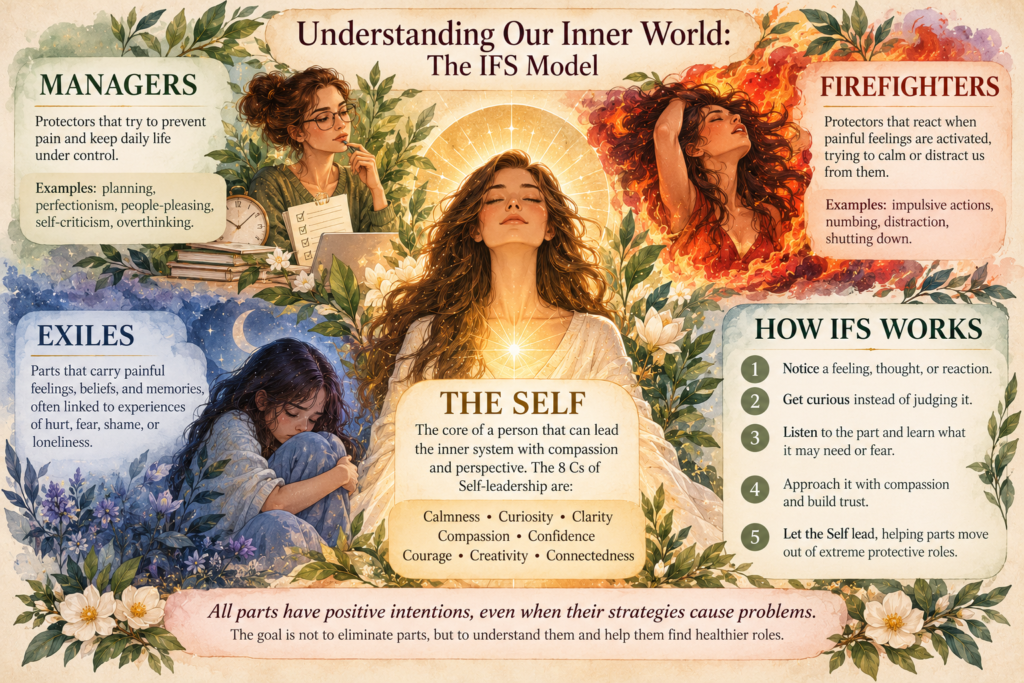
According to IFS, our parts generally fall into three broad categories: Managers, Firefighters, and Exiles.
Don’t worry, you don’t need to memorize these terms to benefit from IFS (but yes, there will be a quiz later! JK, my anxious friend 😅). They’re simply helpful ways to understand some of the patterns we experience.
1. Managers: The parts that try to keep everything under control
Managers are the parts that try to prevent emotional pain by keeping us safe and in control. They might show up as perfectionism, people-pleasing, overthinking, constant planning, or the need to prove ourselves. For example, you might have a part that pushes you to work harder and harder because it believes that if you slow down, you’ll fall behind or disappoint someone. Another part might encourage you to keep everyone happy because it believes that conflict could lead to rejection (and we do NOT like rejection, do we?). These parts can be incredibly exhausting and annoying, especially when they seem to run the show. But from an IFS perspective, they’re not simply bad habits that need to be eliminated. They’re often trying to protect us in the best/only way they know how.
2. Firefighters: The parts that try to make emotional pain go away
While Managers try to prevent difficult feelings from arising, Firefighters tend to jump into action when those feelings become too overwhelming. They might encourage us to distract ourselves, withdraw from others, scroll endlessly on our phones (guilty as charged), overeat, lash out, or do anything else that offers immediate relief.
As you can imagine, these behaviors can sometimes create problems of their own. But IFS invites us to look beyond the behavior and ask a different question: What might this part be trying to help me avoid feeling right now?
That doesn’t mean we have to approve of every behavior or stop taking responsibility for our actions, but what we can do is approach ourselves with curiosity instead of shame, which can open the door to understanding what we actually need.
3. Exiles: The parts that carry emotional pain
Exiles are parts that carry painful feelings, memories, or beliefs, often connected to difficult experiences from earlier in life. They are essentially our traumatized inner child(ren). They might carry feelings of rejection, shame, loneliness, fear, or the belief that we’re somehow not good enough. Sometimes, we may not even realize how much these feelings are influencing our current reactions. A seemingly minor disagreement, for instance, might trigger a much deeper fear of abandonment or rejection, and then we are left wondering what the heck happened.
When this happens, our protective parts may be working overtime to keep us from experiencing that pain again. And this is where things can get interesting. What looks like overreacting, self-sabotage, or an inability to move forward may have a deeper story behind it. Rather than judging ourselves for these reactions, IFS encourages us to approach the underlying pain with care, compassion, and respect for our own pace. The way I think about it is – would you judge and scream at a clearly traumatized child who just needs your help? I would hope the answer is “of course not!” You would probably want to comfort, nurture, and make it feel better, which is exactly what IFS strives to do as well.
What is the Self in IFS?
Now, this is one of my favorite parts of the IFS model! In IFS, the Self refers to an inner state associated with qualities such as calmness, curiosity, compassion, clarity, confidence, courage, creativity, and connectedness. Dick Schwarz describes it as the CORE of who we are beneath our protective and wounded parts.
If you’re interested in spirituality, you might find some parallels here with the idea of reconnecting with your authentic self or deeper inner wisdom. I tend to think of it as the soul, but that’s just my personal understanding of it.
It’s also important to mention that the goal of IFS isn’t to eliminate our parts or become perfectly calm and enlightened human beings who never experience another uncomfortable emotion. (Wouldn’t that be nice, though?) Instead, the idea is to develop a different relationship with our parts, so that we can listen to them, understand them, and respond from a place of greater Self-leadership. In other words, rather than letting fear, shame, or our inner critic make every decision for us, we can learn to approach these experiences with more curiosity and compassion.
How does IFS actually work?

More than anything, IFS is about getting curious about what’s happening inside us and developing a relationship with our different parts. Rather than immediately trying to change a feeling, argue with a thought, or push an uncomfortable emotion away, we slow down and explore the experience.
For example, imagine that you keep putting off something that’s genuinely important to you. You might respond by criticizing yourself: Why am I so lazy? Why can’t I just get my… act together? What’s wrong with me?
But if, instead, you approach the situation with curiosity, you might begin to notice a part of you that’s afraid of failing. Perhaps another part worries about being judged if you succeed. Maybe there’s a part that feels overwhelmed and overworked; it simply wants some much-needed rest.
Instead of fighting these parts, you can begin exploring what they’re concerned about and what they might need you to understand. Sometimes, simply recognizing that a behavior or reaction has a protective intention can change how you relate to it. And as you develop more awareness of these patterns, you may discover new ways of responding that feel more supportive and aligned with what you actually want.
IFS can also involve exploring more painful emotions and traumatic experiences, but this should be approached carefully and at a pace that feels manageable. We don’t need to force ourselves to revisit painful memories or dig into everything at once.
The intention isn’t to force healing but to create the conditions for greater understanding, compassion, and change. And I love how non-pathologizing IFS is as a therapeutic modality. As Derek Scott, the founder of the IFS Counseling Association (IFSCA) in Canada said, “IFS starts on the premise that there’s nothing wrong with us or with any of us.”
How IFS helped me on my own healing journey
If you’ve read my About page, you probably know that my journey hasn’t exactly been a walk in the park. Over the years, I’ve experienced some deeply painful relationship challenges with a covert narcissist, struggled with an autoimmune condition for many years, and spent a considerable amount of time searching for answers through psychology, spirituality, manifestation, and various healing approaches.
For a long time, I was fascinated by the idea that if I could just understand the “correct” principles, change my beliefs, or find the right technique, I could finally get things under control and create the life I wanted. And while those explorations honestly taught me a lot, I eventually realized that constantly trying to fix myself is an exhausting endeavor that never really brought me the lasting peace or a sense of fulfillment I was looking for.
All that finally changed when I came across the Internal Family Systems modality and started to dive deeper into it by reading books and watching IFS demos. It helped me figure out that if I were to start actually healing (physically, mentally, or spiritually), a different approach was necessary. Instead of treating my inner struggles as evidence that something was wrong with me, I began learning to approach them with curiosity and an open heart. I could explore why certain reactions showed up, what different parts of me might be afraid of, and how some of my protective patterns had developed.
I began to understand that even the parts of me I found frustrating or wanted to get rid of have been trying, in their own… interesting way (the only way they knew how), to protect me from pain. Of course, I am still learning, and I feel like healing and getting to know one’s inner world is a lifelong endeavor that never really ends. But I do find this approach much more compassionate, helpful, and, honestly, much more interesting than treating myself as a never-ending self-improvement project.
After IFS became an important part of my healing journey, my own experience inspired me to learn how to support others in exploring their inner worlds.
I believe that sometimes we don’t need another person telling us what’s wrong with us or giving us yet another list of things we need to change. Sometimes, we just need the opportunity to slow down, listen to ourselves, and understand what’s happening beneath the surface. And that brings me to what I’m doing now!
My IFS training and coaching approach
With my background in psychology (BA in Psychology and MA in Educational Psychology, with additional coursework in Counseling Psychology) I was immediately drawn to IFS because it offered a way to understand our inner world that felt deeply compassionate and helpful. I’ve also spent years exploring personal growth, spirituality, and different approaches to healing, but it wasn’t until I came across IFS that I felt like I had finally found the missing piece of the puzzle.
Although I have been learning about IFS informally for the past year, I realized that personal study alone wasn’t enough to prepare me to work with others using this approach. That is why I am now completing a structured, comprehensive IFS training program, which I hope to finish by May 2027. After that, I plan to start offering IFS-informed services to help others explore their inner world with greater compassion and understanding. If you are interested in working with me in the future, please stay tuned! I will update this blog post and share more details here as I continue this journey.
Is IFS right for you?

You might find IFS interesting if you’ve ever:
- Felt stuck in recurring emotional or relationship patterns.
- Struggled with a harsh inner critic or persistent self-doubt.
- Found yourself torn between different wants, needs, or decisions.
- Wondered why you react so strongly to certain situations.
- Tried to change a habit or behavior but found yourself returning to the same pattern.
- Wanted to understand yourself more deeply rather than simply trying to force yourself to change.
- Been curious about developing more self-compassion and a better relationship with your emotions.
IFS is certainly not the only approach to personal growth, and it isn’t necessarily the right fit for everyone. But if the idea of understanding your inner world rather than constantly fighting with yourself resonates with you, I highly recommend it! You also don’t need to know anything about IFS before getting started. You don’t need to be particularly spiritual, have experience with meditation, or know the names of all your inner parts. You can simply begin with curiosity about yourself.
A Final Thought
One thing I’ve come to appreciate through my own journey is that we don’t necessarily have to understand every detail of our past, figure out why everything happened the way that it did, or become some idealized version of ourselves before we can begin living more fully.
Sometimes, meaningful change begins with something much simpler: learning to actually listen to ourselves. What if the part of you that keeps procrastinating isn’t simply lazy? What if the part that constantly worries isn’t trying to ruin your life? What if the inner critic you’ve been fighting for years is operating from fears and beliefs that you’ve never really had the chance to understand?
You don’t have to accept every thought or follow every impulse. But you can become curious about what’s happening inside you and begin responding to yourself with a little more compassion.
For me, that’s one of the most valuable things about IFS: it gives us a way to approach our inner world with greater understanding, rather than seeing ourselves as a never-ending project that needs fixing. And if there’s one thing I’d love for you to take away from this blog post, it’s this:
You don’t have to fight yourself to grow. Sometimes, the path forward begins when you finally start listening to your soul.💗
With love,
Olga 💞


